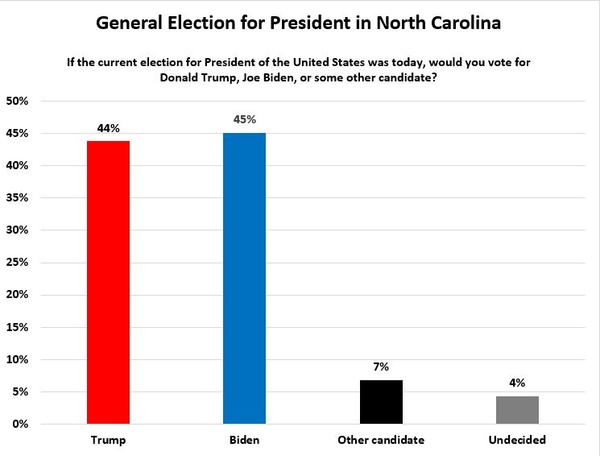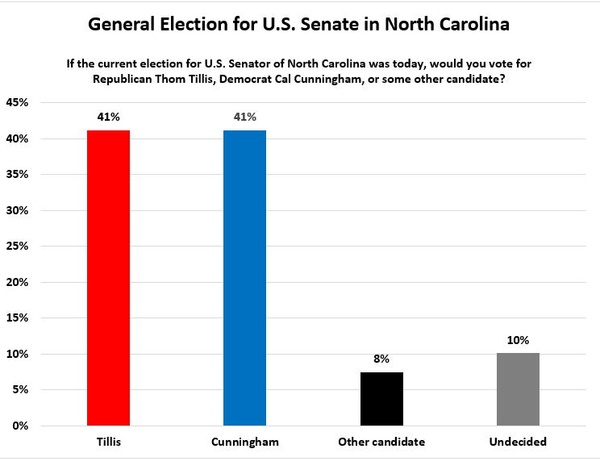
The latest ECU poll, conducted June 22-25, shows a virtual tie in the race for president in North Carolina, with former Vice-President Joe Biden leading President Donald Trump among registered voters by one percentage point (45% to 44%). The state’s contest for United States Senate, which pits incumbent Republican Thom Tillis against Democratic challenger Cal Cunningham, shows another highly competitive matchup, with registered voters evenly split (41% to 41%). In the race for governor, Democratic incumbent Roy Cooper currently holds a lead of eleven percentage points over Republican challenger Dan Forest (49% to 38%).
Although Cooper’s lead has slightly declined from a previous ECU Poll taken in May that showed him ahead by fifteen percentage points, the Governor’s approval ratings remain high. Approximately 52% of registered voters in North Carolina approve of Governor Roy Cooper’s overall job performance, with 36% disapproving. Similarly, 53% approve of Cooper’s handling of the coronavirus outbreak in North Carolina, with 34% disapproving. (Cooper’s overall and coronavirus approval ratings, however, have declined since the previous ECU Poll in May.)
By comparison, 44% of registered voters in North Carolina approve of President Trump’s overall job performance, with 51% disapproving. When asked about President Trump’s handling of the federal government’s response to the coronavirus, 42% percent approve compared to 51% who disapprove. An even smaller percentage (35%) approve of President Trump’s handling of the nationwide protests over the death of George Floyd in Minneapolis, while 52% disapprove.
The poll results show that there is continued worry about the spread of the coronavirus in North Carolina, and that those who are concerned are the most likely to take precautions. Overall, 62% reported that they are “worried” or “very worried” about the spread of coronavirus cases in North Carolina, while only 13% report that they are “not at all worried.” Of those “worried” or “very worried” about the spread of the coronavirus cases in the state, more than nine of ten (93%) report that they usually wear a face mask when out shopping. Among those who are only slightly worried or not at all worried, the percentage of those who wear a face mask when out shopping drops to 48%. The percentage of those who report wearing a face mask when out shopping falls further to 21% when examining only those who are not at all worried about the spread of the coronavirus.
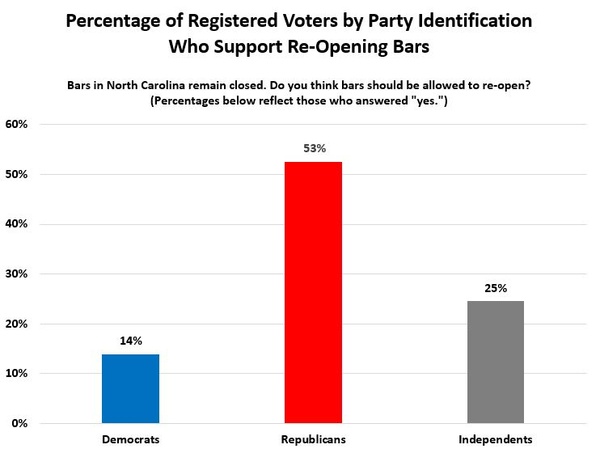
When turning to the economic impact of the coronavirus, about one-in-three (32%) say their household economic situation has gotten worse since the outbreak of the pandemic, while 59% say their situation is the same. Voters also have mixed views on the re-opening process. For instance, half (50%) of registered voters think it was the correct decision to re-open dine-in services at restaurants, while 38% think it was the wrong decision. When asked whether bars should be allowed to re-open, a majority (54%) said no, while only one-third (33%) said yes.
Moreover, when it comes to re-opening restaurants and bars, there is a partisan divide in North Carolina. For instance, only 29% of self-identified Democrats think dine-in services should have resumed, compared to 72% of Republicans. Similarly, 53% of Republicans think that bars should be allowed to re-open, compared to 14% of Democrats.[1]
In summarizing the results of the poll, the Director of the ECU Center for Survey Research, Dr. Peter Francia, commented, “If the election was today, North Carolina would be one of the most competitive states in the nation in contests for President and U.S. Senate. In the race for governor, Roy Cooper remains the favorite.” Francia added, “Cooper continues to receive generally high marks from the public for his handling of the state’s response to the coronavirus and for the job that he has done as governor overall. The approval numbers for President Trump, by comparison, are not as strong. This likely explains, at least to some degree, why Cooper currently holds a double-digit lead in the polls, whereas President Trump is locked in a virtual tie with Joe Biden in North Carolina.”
[1] Democrats include independents who answered that they “lean” toward the Democratic Party. Republicans include independents who answered that they “lean” toward the Republican Party.
Methodology
This poll was conducted June 22-25, 2020. The sample consisted of 1,149 registered voters in North Carolina, with a Credibility Interval (CI) similar to a poll’s margin of error (MOE) of +/- 3.4 percentage points. The data were weighted by age, education, race, gender, mode, and 2016 election modeling. Data were collected using both an Interactive Voice Response (IVR) system of landlines only (n=770) and an online panel provided by Lucid (n=379).