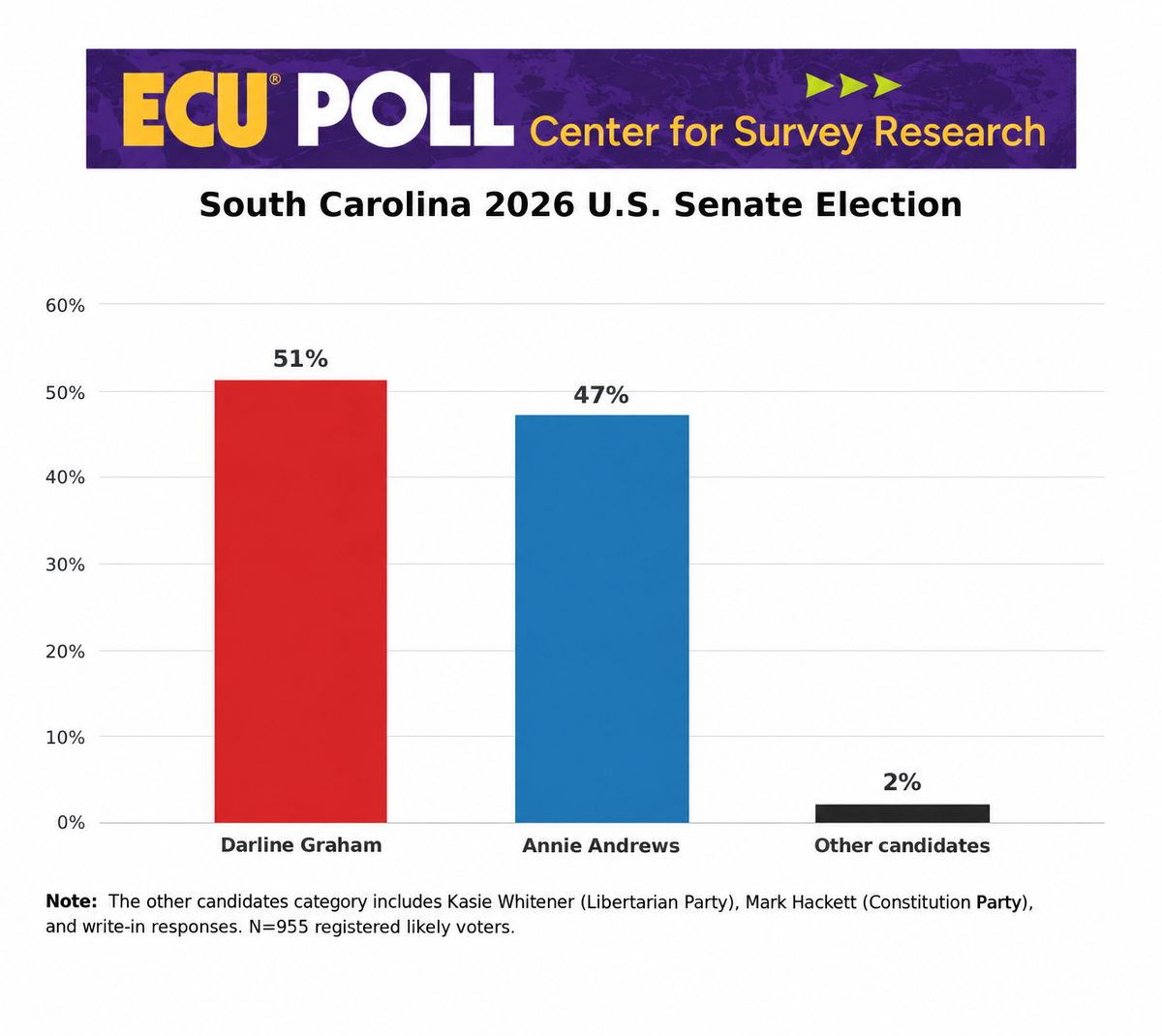
The latest ECU Poll of South Carolina’s U.S. Senate race, conducted October 19–24, shows former Republican Senator Darline Graham leading Democratic challenger Annie Andrews by four percentage points among likely voters, 51% to 47%. Another 2% support an independent, minor-party, or write-in candidate. The poll has a credibility interval of ±3.7 percentage points, comparable to a margin of error.
Andrews holds a slight advantage in favorability with 44% of respondents reporting a favorable opinion toward her and 36% reporting an unfavorable opinion. Graham, by comparison, has a 39% favorable rating and a 38% unfavorable rating.
When asked which issue is most important in determining their vote in the upcoming election, the top issue was the economy and/or the overall cost of living at 54%. Among those who cited this issue as the most important, Andrews leads Graham 56% to 41%. Additional issues of top concern included border security and/or immigration (14%) and the conflict with Iran and/or other foreign policy issues (7%). Among those voters who selected border security and/or immigration as the top issue, Graham holds a large advantage over Andrews, 95% to 5%. Other top issues that respondents selected in the poll included affordability of health care (6%) and crime and/or public safety (6%).
The results of the poll also reveal some notable differences among key segments of the electorate. Andrews is leading among Independents, 53% to 43%, but Graham leads among male voters by a wide margin of 20 percentage points (59% to 39%). Andrews does lead the female vote, but by a narrower margin, 54% to 44%. Additionally, Graham leads among white voters, 67% to 31%. By contrast, Andrews garners significant support from African American voters, who favor her over Graham by a margin of 88% to 9%.
Graham leads among senior voters (65 years or older) as well, 56% to 43%, whereas Andrews holds a 17-point advantage among younger voters (18 to 29 years old), 58% to 41%. Voters are further divided by education level. Among those who are not four-year college graduates, Graham leads by a double-digit margin, 55% to 44%. Among voters with a four-year college degree, Andrews leads by a narrower margin, 51% to 47%.
In assessing the full results of the poll, Dr. Peter Francia, Director of the ECU Center for Survey Research, remarked, “South Carolina’s U.S. Senate race was once widely expected to be a Republican win. It is now a very competitive election. Graham’s narrow lead in our poll mainly reflects her strength among Republican voters. Andrews leads Democrats by a wide margin and is also ahead among independents. Nonetheless, in this poll, Graham’s Republican margin is enough to put her slightly ahead overall.”
Methodology
This ECU Poll was conducted October 19 through 24, 2026. The results are based on 955 completed responses to the poll’s questionnaire from South Carolina registered voters who are likely to vote in the 2026 general election. The survey combined a random sample of registered voters statewide with an online panel used to supplement responses from voters ages 18 to 29, Hispanic voters, and African American voters.
Respondents completed the survey via cell phone using MMS-to-web text (N=413), with the sample provided by ReconMR via L2, and an Interactive Voice Response (IVR) system of landlines only (n=184). The sampling design intentionally oversampled populations that are traditionally difficult to reach in public-opinion surveys. To supplement the data further, an online panel (N=358) was provided by Bovitz. Quality checks on the data were put in place to remove respondents who repeatedly rushed through questions, provided straight-line responses, or provided inconsistent answers.
The credibility interval (CI), which is similar to a margin of sampling error, is +/- 3.7 percentage points. (Please note that credibility intervals are larger for results based on subsamples, including demographic groups and party identification.) The data were weighted to reflect the population of likely 2026 general election voters in South Carolina based on age, education level, race/ethnicity, gender, region, and party identification, as well as election modeling based on previous statewide elections in South Carolina. All percentages are rounded to the nearest whole number. As a result, percentage totals in some instances may be slightly higher or lower than 100%.
The Center for Survey Research at East Carolina University conducts nonpartisan public opinion polling on elections, politics, and public policy issues in North Carolina and across the nation.
SOURCE: ECU Center for Survey Research