The latest ECU Poll of North Carolina’s U.S. Senate race, conducted September 30 through October 3, finds Democratic nominee Roy Cooper leading Republican nominee Michael Whatley, 50% to 43%, with only 6% remaining undecided and 2% supporting a minor-party or write-in candidate. The seven-point margin is the same as in our report from last month, although the share of undecided voters has dropped from 14% to 6%. In a forced-choice scenario in which “undecided” is removed as an option, Cooper’s lead remains at seven percentage points, with 53% supporting Cooper and 46% supporting Whatley. The poll has a credibility interval of +/- 4 percentage points, which is similar to a traditional margin of error.
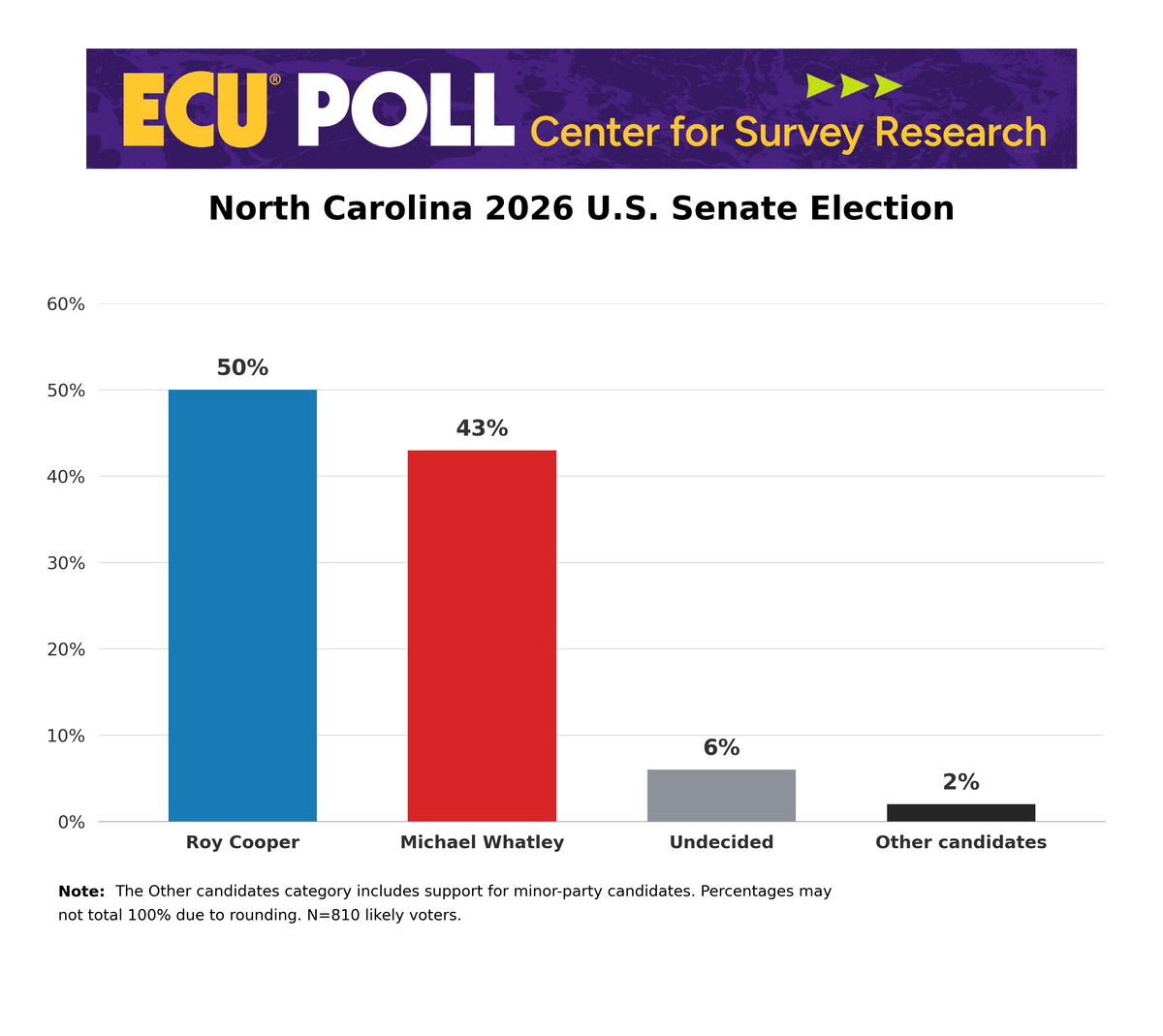
Cooper’s advantage is driven in part by his performance among independent voters. On the initial measure, which allows respondents to remain undecided, Cooper leads Whatley among self-described independents by 16 points, 52% to 36%, with about 7% still undecided. Cooper also holds a net-positive favorability rating, with 48% viewing him favorably and 43% unfavorably, while Whatley’s ratings are 31% favorable and 43% unfavorable.
When asked to identify the most important issue in deciding their vote in the upcoming election, 55% of likely voters point to the economy, including concerns about the cost of living. Border security and/or immigration ranks a distant second at 11%, followed by the conflict with Iran and/or other foreign policy issues at 8%. The affordability of health care and crime and/or public safety are each cited by 6% of likely voters. Among voters who identify the economy and cost of living as their most important issue, Cooper’s lead over Whatley widens substantially, to 60% versus 31%.
As North Carolina voters look ahead to the upcoming election, President Donald Trump’s approval ratings continue to lag. Among likely voters, 40% approve of the job Trump is doing as president, compared with 57% who disapprove. Governor Josh Stein, by comparison, receives net-positive evaluations, with 43% approving of his job performance, 29% disapproving, and 27% unsure.
Cooper leads Whatley among African American voters, 82% to 11%, while Whatley leads among white voters, 53% to 39%. Whatley also holds a slim lead among men, 49% to 44%, while Cooper leads by a wider margin among women, 54% to 37%.
Among likely voters without a four-year college degree, Whatley holds a slight lead over Cooper, 48% to 44%. However, among those with a four-year college degree or higher, Cooper leads Whatley, 58% to 35%. Whatley leads among voters age 65 and older, 51% to 45%, while Cooper leads among those under age 65, 51% to 39%.
In assessing the full results of the poll, Dr. Peter Francia, Director of the ECU Center for Survey Research, remarked, “Roy Cooper has maintained his lead over Michael Whatley since the previous ECU Poll, while the share of undecided voters has declined. A majority of likely voters identify the economy and cost of living as their top issue, and Cooper is winning these voters decisively. Whether Whatley can gain ground among these voters will be a key factor in determining whether the race tightens in the final weeks before Election Day.”
Methodology
This ECU Poll was conducted September 30 through October 3, 2026. The results are based on 810 completed responses to the poll’s questionnaire from North Carolina registered voters who are likely to vote in the 2026 general election. The survey combined a random sample of registered voters statewide with an online panel used to supplement responses from voters ages 18 to 29 and Hispanic voters.
Respondents completed the survey via cell phone using MMS-to-web text (N=587), with the sample provided by ReconMR via L2. The sampling design intentionally oversampled populations that are traditionally difficult to reach in public-opinion surveys. To supplement the data further, an online panel (N=223) was provided by Verasight, which recruits respondents directly using random address-based sampling, random person-to-person text messaging, and dynamic online targeting. Quality checks on the data were put in place to remove respondents who repeatedly rushed through questions, provided straight-line responses, or provided inconsistent answers.
The credibility interval (CI), which is similar to a margin of sampling error, is +/- 4 percentage points. (Please note that credibility intervals are larger for results based on subsamples, including demographic groups and party identification.) The data were weighted to reflect the population of likely 2026 general election voters in North Carolina based on age, education level, race/ethnicity, gender, region, and party identification, as well as election modeling based on previous statewide elections in North Carolina. All percentages are rounded to the nearest whole number. As a result, percentage totals in some instances may be slightly higher or lower than 100%.
The ECU Center for Survey Research, which directed this poll, is a member of the AAPOR Transparency Initiative (TI). For additional information about the ECU Poll and its methodology, please refer to the documentation provided in the TI report.
SOURCE: ECU Center for Survey Research